
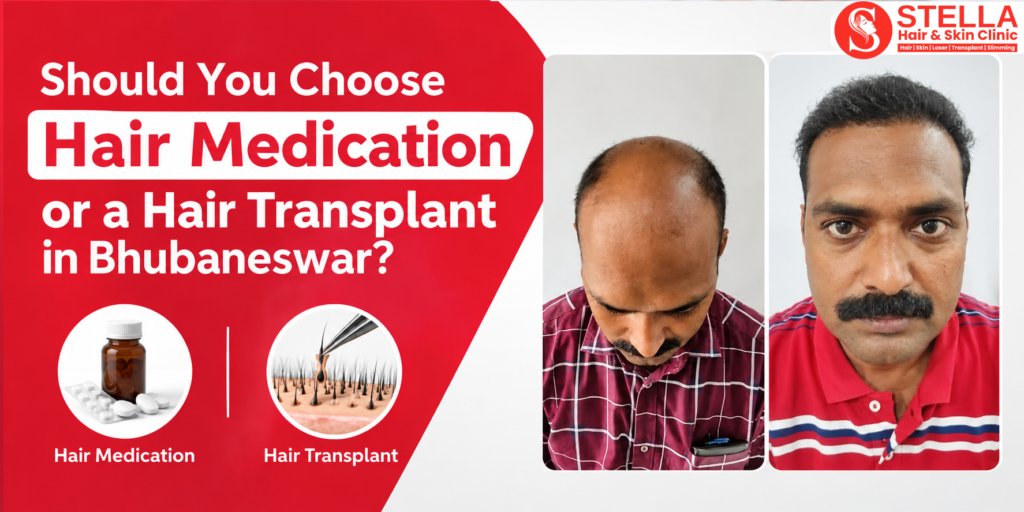
The choice between hair medication and a hair transplant will depend on the stage of your hair loss, your budget and how permanent you want the result to be. Medication works best early on, while follicles are still active. Once they’ve stopped producing hair altogether, a transplant becomes the more realistic option. At Stella Clinic, we specialise in transplants and help you honestly figure out which stage you’re at before recommending anything. We offer a painless hair transplant treatment in Bhubaneswar once medication alone won’t cut it anymore.
Table of Contents
- Can Medication Alone Regrow Hair, or Does It Only Slow Down Further Loss?
- What Happens to Your Hair Loss Progress if You Stop Taking Medication?
- Why Is a Hair Transplant Considered a Permanent Solution?
- When Should You Switch From Medication to a Hair Transplant?
- Do You Still Need Medication After Getting a Hair Transplant?
Can Medication Alone Regrow Hair, or Does It Only Slow Down Further Loss?
Medication generally protects the hair that’s already there rather than producing new growth in fully bald areas. At Stella Clinic, we specialise in hair transplants, so once hair loss has reached the point where medication can’t do much more, that’s exactly where we come in. The two options that come up most often in this space are:
- Minoxidil: a topical solution applied to the scalp to support blood flow and encourage gradual thickening.
- Finasteride: an oral option that works by blocking the hormone linked to shrinking follicles.
The minoxidil vs finasteride hair loss comparison usually comes down to where each one works, on the surface or from within, though neither one brings back hair where none is left.
What Happens to Your Hair Loss Progress if You Stop Taking Medication?
If you stop taking the medication, the hair loss usually starts up again, because the medicine was only holding it back, not curing it. A transplant doesn’t have that problem, since it’s not something you take every day that can just stop working. Our team at Stella Clinic uses hair from the back of your head, an area that’s naturally resistant to the hormone that causes baldness in the first place, so that hair keeps growing on its own, permanently. This is why so many people eventually choose permanent hair loss treatment in Bhubaneswar instead of staying on medication for years.
Curious what the surgery actually feels like? Read this: Does Hair Transplant Surgery Hurt? Here’s What Actually Happens
Why Is a Hair Transplant Considered a Permanent Solution?
A transplant lasts because the follicles keep doing exactly what they were doing before, growing hair, without you needing to take anything or apply anything every day. At Stella Clinic, we see this as the main reason patients choose us over staying on tablets or topical treatments indefinitely.
Once people understand how permanent hair transplant results actually work, it’s easier to see why so many are looking for a natural hairline restoration clinic in Bhubaneswar instead of committing to a lifelong prescription.
When Should You Switch From Medication to a Hair Transplant?
Medication loses its usefulness once bald patches stop shrinking with continued use, or when your hair loss pattern is strongly hereditary and unlikely to reverse with tablets alone. That’s usually the point to think about a permanent solution. At Stella Clinic, we check your exact stage of hair loss before suggesting anything, so you’re not moving to surgery too early or too late.
We provide advanced Follicular Unit Extraction, extracting and placing single follicles for natural-looking, permanent results. We’ll walk you through the process, recovery, and what to expect, and tell you honestly if it’s time to make the switch.
Do You Still Need Medication After Getting a Hair Transplant?
The post-op medication is more to protect your existing hair, not the transplanted follicles, which will grow on their own once they take root.
At Stella Clinic, we make this clear at your consultation so you are not left with any confusion. It often comes down to a few things: slowing thinning in areas outside the transplanted zone, keeping your scalp healthy while it heals, and lowering the chances of further loss around the newly restored area.
If we do recommend medication for you, we’ll tell you exactly why and for how long, so it’s never a guessing game.
Book Your Hair Transplant Consultation at Stella Clinic
The right treatment choice depends on how far the hair loss has gone. Medications may help early on, but once baldness sets in, hair transplant surgery does the real work. Knowing what permanent hair transplant results actually look like makes the decision simpler, and a proper consultation is often the fastest way to get clarity.
Contact Stella Clinic today to get a clear, honest opinion on which path fits your hair loss stage best. A quick consultation can save months of guessing and give a proper roadmap based on your actual hair loss stage.
Stay tuned for the next blog, where we will cover another hair loss question people ask all the time.
Frequently Asked Questions
Will medication work if the hairline has already receded a lot?
Once the hairline is fully gone in a spot, medication won’t really bring it back; it just helps protect whatever hair is still around.
How soon will results show after a hair transplant?
It takes a few months to start seeing real growth, and it keeps getting better after that, so patience is key.
Is a hair transplant a one-time procedure, or does it need touch-ups later?
For most people, it’s a one-time thing, since the transplanted hair keeps growing on its own without needing repeat sessions.